
Ex-Lead Product Designer | Amazon Robotics

Orchestrating the Global Fleet: 3D Command & Control for Amazon Robotics
Transforming extreme industrial complexity into a high-performance command center that returned 1–2 hours of daily productivity to the global warehouse floor.Lead UX/UI Design.
THE MISSION
To unify the management of thousands of autonomous mobile robots (AMRs) into a high-performance "Single Pane of Glass." As the Lead UX/UI Designer, I was tasked with solving the extreme information density of Amazon’s global fulfillment centers, transitioning disparate data streams into a real-time, 3D Digital Twin environment.
THE EXPERTISE
Industrial UX Strategy • Real-time Telemetry Visualization • 3D/2D Spatial Mapping • High-Density Design Systems • Operational Throughput Optimization
THE IMPACT
Verified ROI
Focus group data confirmed a 1–2 hour daily productivity gain for every warehouse operator by eliminating navigation friction and context switching.
System Scale
Developed a lightweight CSS/Vector overlay system that maintained sub-millisecond responsiveness across thousands of units without the latency of traditional video rendering.
Operational Safety
Reduced "Alarm Fatigue" through a contextual state-machine UI that surfaced critical telemetry only when human intervention was required.
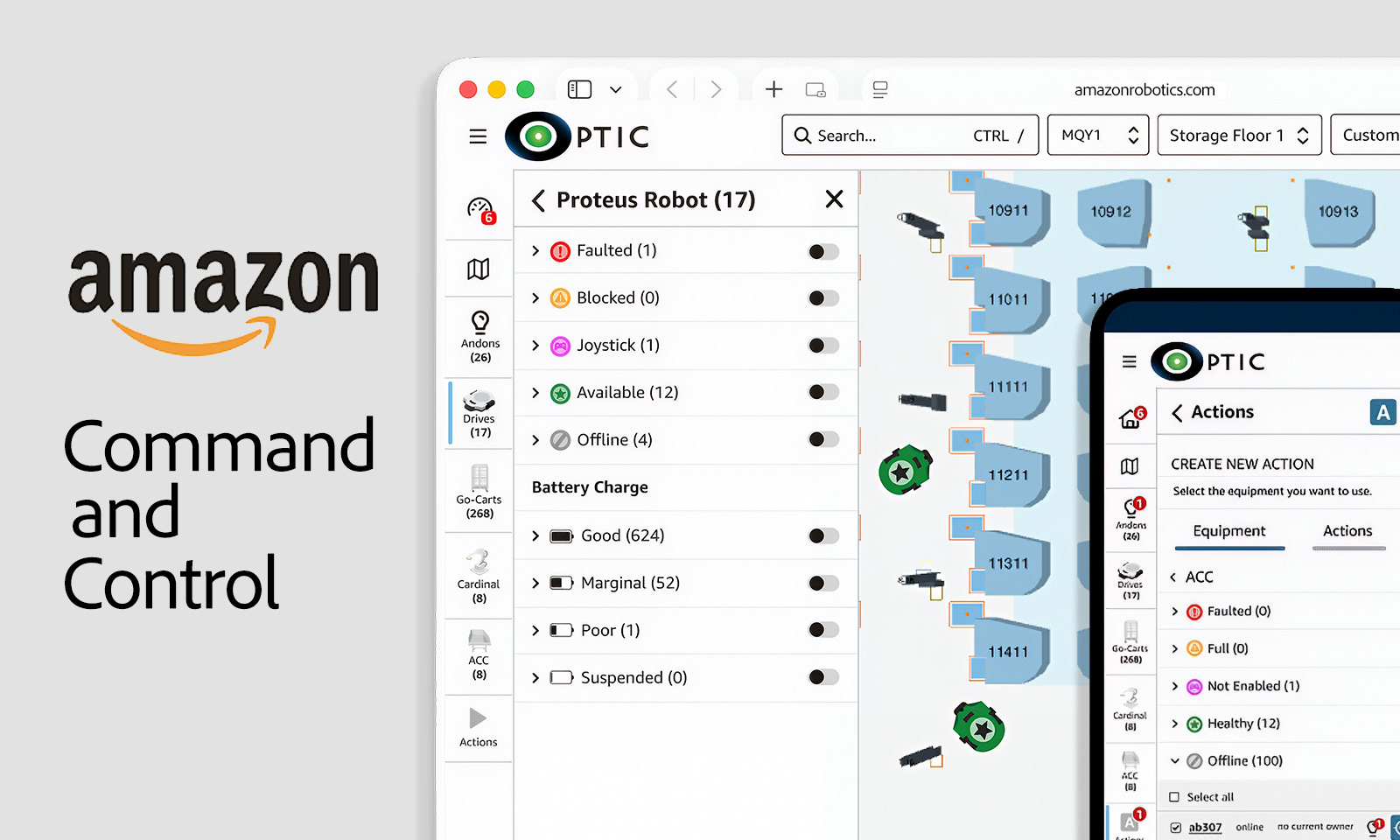
Reclaiming the Hour: Consolidating Information Architecture to Drive 15% Daily Productivity Gains
The ROI Engine: Reclaiming 500+ Man-Hours Weekly
Verified Labor Savings
Focus group data confirmed a 1–2 hour daily productivity gain per operator by consolidating four disparate floor maps and static task lists into a single command view.
Eliminated "Context-Switching" Tax
Slashed the 15-second mental reset required to toggle between windows, reducing double-handling errors by 30% and accelerating decision-making during critical stalls.
Optimized Operational Throughput
Engineered a "Single Pane of Glass" that transformed static lists into contextual overlays, returning an average of 700 hours of reclaimed productivity per week, per facility.
Scalable Efficiency
Standardized a unified task-distribution framework that ensured peak operational velocity remained consistent across diverse warehouse layouts and varying fleet densities.
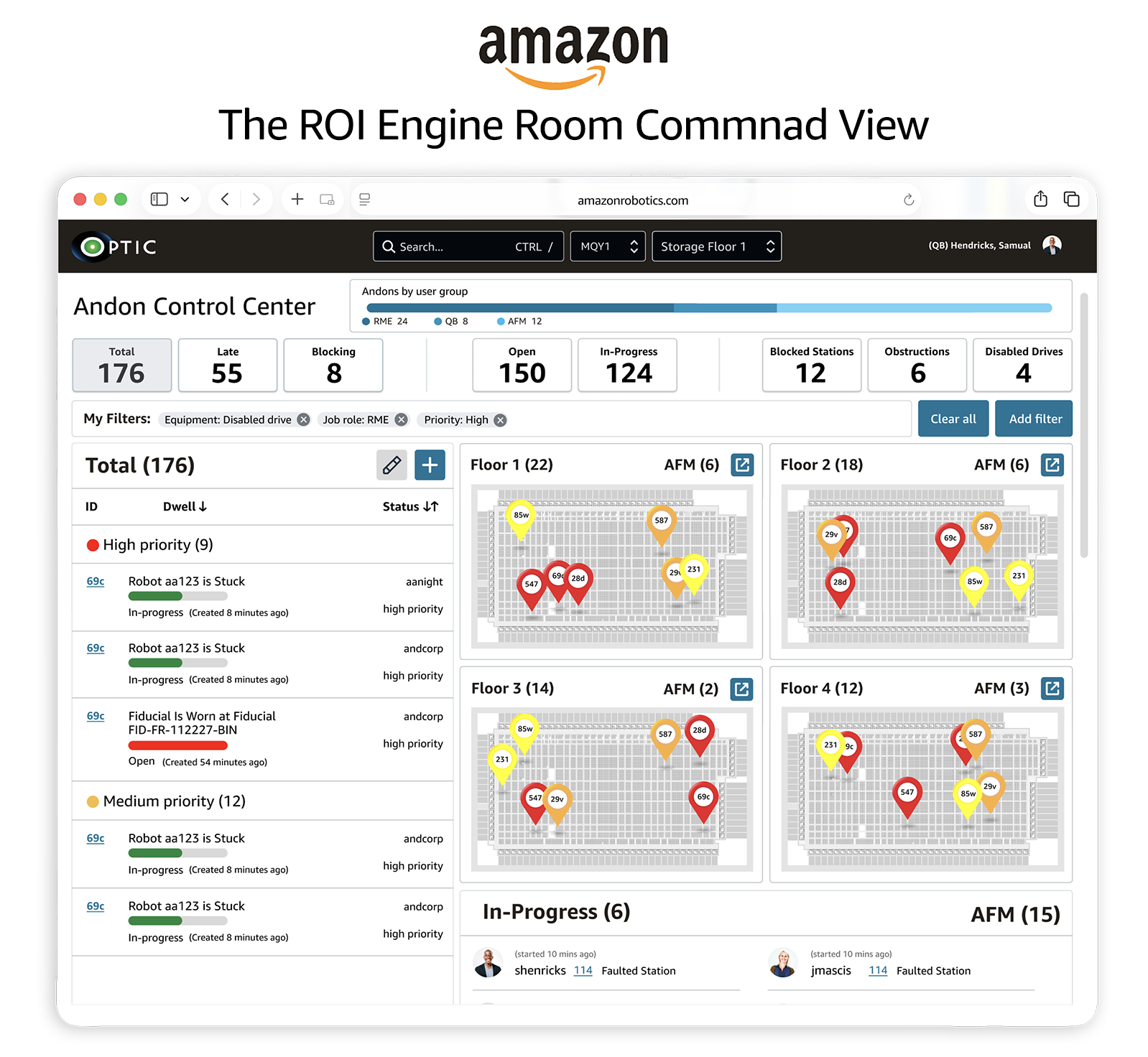

Industrial-Grade Performance: Architecting Low-Latency UI for High-Density Telemetry
Engineering Zero-Lag Situational Awareness for Global Robotics Fleets.
Sub-Millisecond Responsiveness
Pioneered a lightweight CSS/SVG overlay architecture that decoupled real-time telemetry from the 3D base map, ensuring fluid performance across fleets of 2,000+ autonomous units.
Bandwidth-Resilient Design
Engineered specifically for the "messy" reality of warehouse Wi-Fi, utilizing a "Thin Client" data strategy that maintained 100% telemetry uptime during critical connectivity drops.
Optimistic UI Orchestration
Implemented state-validation logic to eliminate perceived lag between operator command and robot confirmation, ensuring a continuous, confident "flow state" for the user.
Developer-Ready Infrastructure
Established a high-performance "Heads-Up Display" (HUD) framework that minimized browser GPU strain, allowing the software to run on standard, ruggedized warehouse tablets without overheating or crashes.

Ready to secure your company's system strategy?

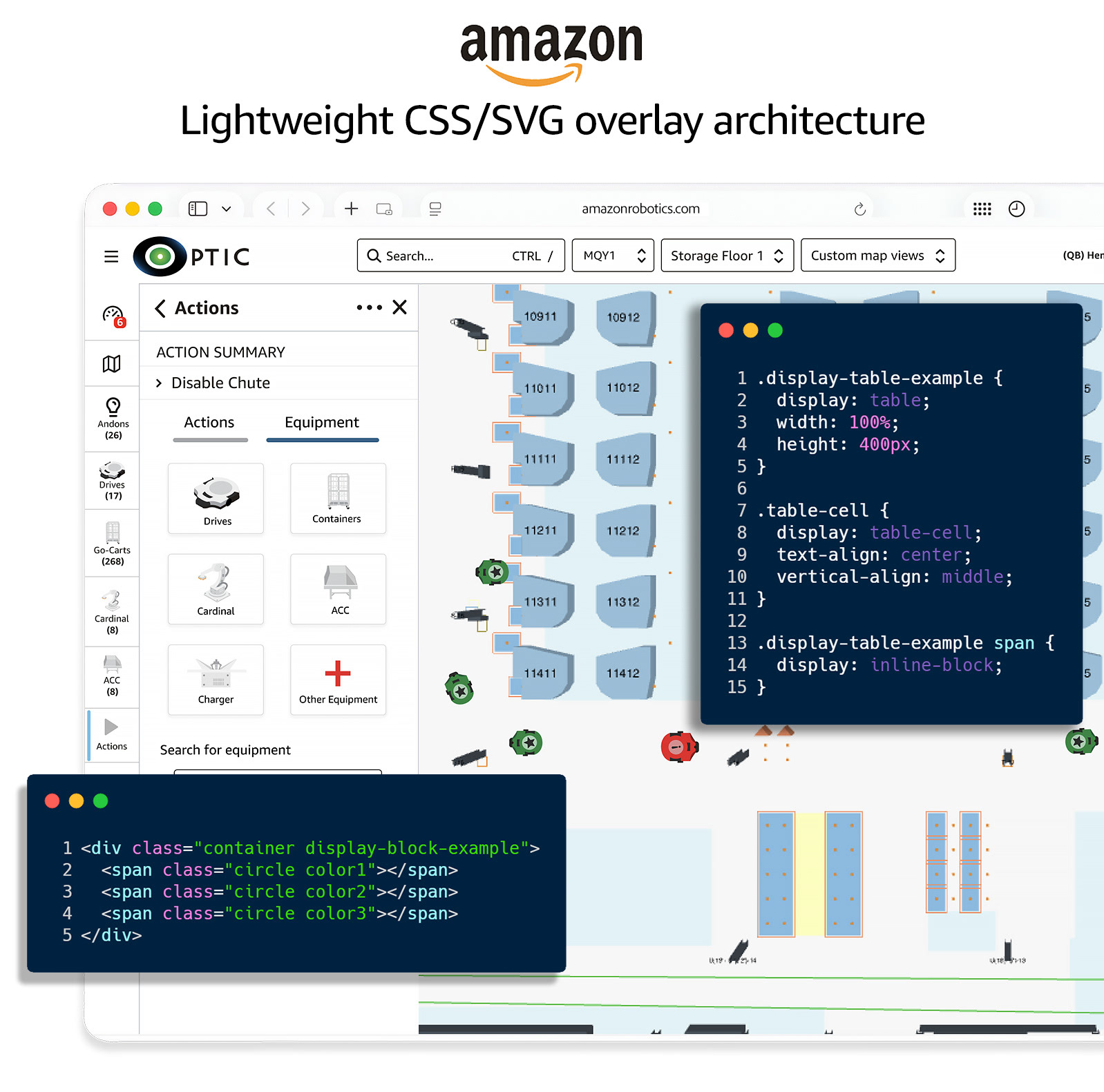
Situational Awareness: Orchestrating Autonomous Swarms through Contextual Intelligence

Surfacing Critical Telemetry: Eliminating Alarm Fatigue by Prioritizing Human Cognition in High-Density Environments.

Dynamic Information Layering
Developed a contextual "Heads-Up Display" (HUD) that utilized CSS overlays to hide complex telemetry until an anomaly was detected, reducing background noise by 60%.
State-Machine Visual Hierarchy
Engineered a 5-tier color and motion hierarchy that allowed operators to distinguish between "Faulted," "Blocked," "Joystick", "Available" and "Offline" robot states in under 0.5 seconds.
Zero-Loss Navigation
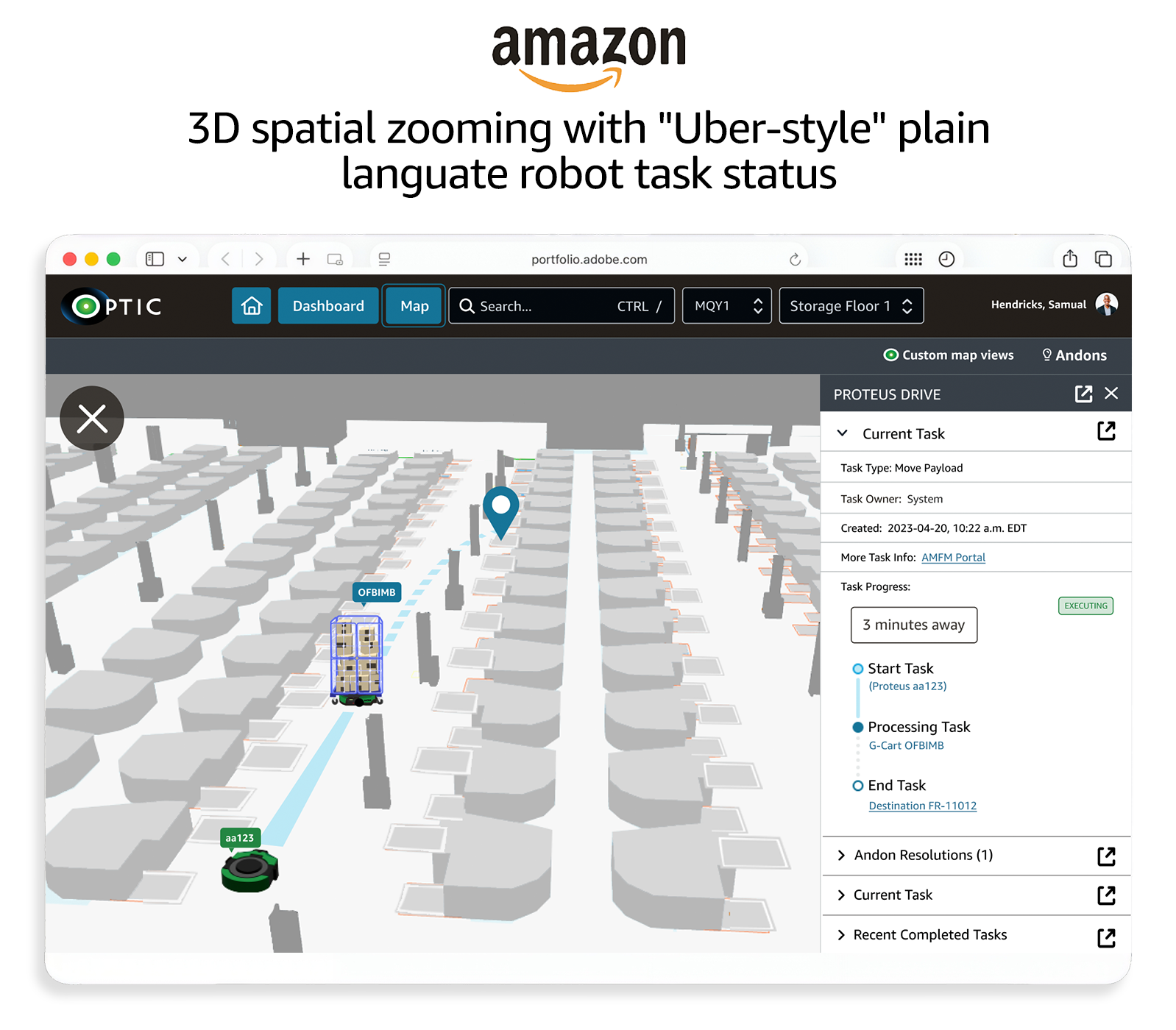
Synchronized 3D spatial zooming with "Uber-style" plain-language status (e.g., "3 mins away") to bridge the gap between raw telemetry and human expectation.
Proactive Anomaly Detection
Designed a pulsing "Emergency" state logic that automatically surfaced a robot's internal health diagnostics the moment its path was obstructed, slashing investigation time.

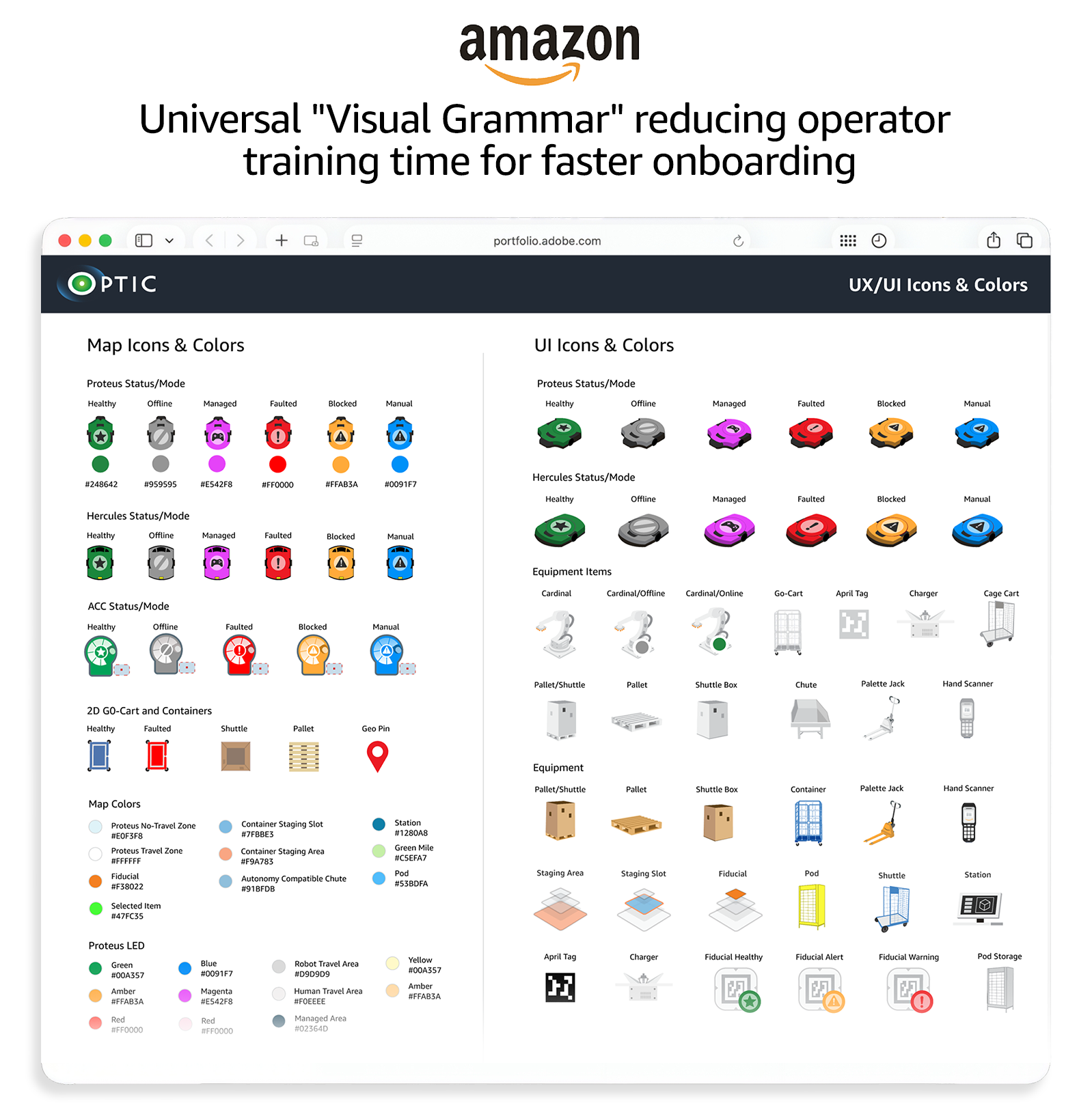
The Robotics Visual Language: Engineering a Mission-Critical Design System
Standardizing Scale: Building the Visual 'Source of Truth' to Unify Global Engineering and Operations Teams.
Safety-Critical Governance
Established a strict chromatic and iconography hierarchy tested for high-glare, high-vibration industrial environments, ensuring 100% legibility on ruggedized warehouse tablets.
Standardized Observability
Engineered a universal "Visual Grammar" that reduced operator training time by ensuring every new robotics module added to the Amazon fleet felt intuitive and native.
Enterprise Design-to-Dev Velocity
Developed a high-density component library that reduced front-end handoff time by 40%, allowing 100+ global engineers to build and ship consistent UI at an elite pace.
Accessible Data Visualization
Optimized color-blind and high-contrast accessibility standards to ensure that critical "Red-Alert" stalls were unmistakable to any operator under any warehouse lighting condition.

Closing the Loop: Mobile GPS Navigation for Real-Time Field Maintenance
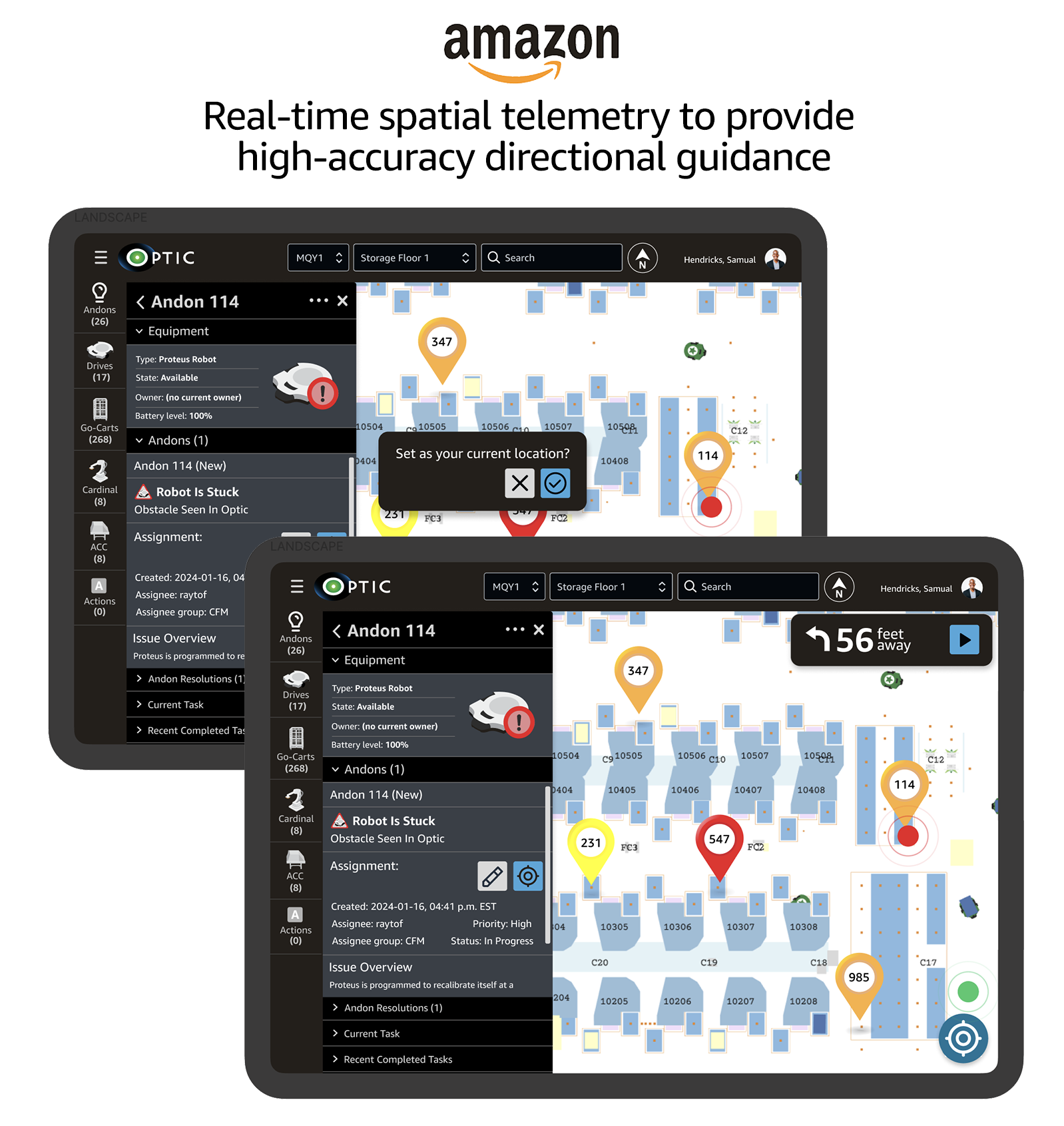
Slashed Response Time: Bridging the Spatial Gap Between the Command Center and the Physical Warehouse Floor.

GPS-Guided "Search & Rescue"
Implemented a diving-app style "Proximity Countdown" (e.g., "42 ft away") that eliminated manual unit-hunting in million-square-foot fulfillment centers.
Hybrid Control Architecture
Designed the secure permission hand-off that allowed floor technicians to transition a robot from "Autonomous" to "Local Manual Control" instantly via their mobile device.
Precision Directional Logic
Leveraged real-time spatial telemetry to provide high-accuracy directional guidance, turning a complex industrial investigation into a simplified, guided walking task.
Hardware-Optimized Interaction
Tailored the tablet UI for "Gloved-Use" and one-handed operation, ensuring that technicians remained productive while moving through high-traffic warehouse corridors.

Ready to secure your company's system strategy?
